Superiority of Priesthood over Lay Believers
All Buddhist traditions, except for Nichiren Shoshu - take the Three Treasures: The Buddha, Dharma and Community of Believers - as the most valued teaching of Buddhism.
The Treasure of the Community in Nichiren Buddhism includes both priests and Lay believers. However, Nichiren Shoshu Priesthood does not agree that priests and lay believers are spiritually equal.
Obsession with “Spiritual Hierarchy”
Nichiren Shoshu Priests consider themselves as a “higher class of spirituality”, a class that lay believers cannot equal:
“To talk about the priesthood and laity with a sense of equality are expressions of great conceit. In fact, they correspond to the five cardinal sins…”
Source: Nichiren Shoshu Head Temple’s chief administrator, Nichijun Fujimoto, 12 Jan.1991.
The Lotus Sutra states that the Buddha-nature equally exists in all people, and that the Bodhisattvas - the ordinary people who propagate Buddhism - possess the same valued spirituality as priests.
On the equality of all believers before the Law, Nichiren states:
“Now in the Latter Day of the Law, if any person embraces Myoho Renge Kyo and practices it in accordance with the Buddha’s teachings - whether he be…priest or lay believer, or of high or low position - he cannot fail to attain Buddhahood”.
Source: Nichiren letter: Teachings, Practice and Proof
And:
"…anyone who teaches others even a single phrase of the Lotus Sutra is the envoy of the Thus Come One, whether that person be priest or layman, nun or laywoman"
Source: Nichiren Letter: A Ship to Cross the Sea of Suffering
Dividing the Community of Believers
Dividing people into two categories: superior and inferior - is not a Buddhist way of thinking. There are no “special people” or a “class of priests” in Nichiren Buddhism.
In the doctrine of the “Ten Worlds”, the world of Bodhisattva (leading to Buddhahood) is the essence of the life of both priests and ordinary people. But the Priesthood of Nichiren Shoshu introduce their own “Class” in between the Bodhisattva and Buddha, as if they constitute the “11th World”.
Apart from Bodhisattva and Buddha there is no ‘world" or “class” of priesthood.
Who is Bodhisattva?
In his letter, The True Aspect of All Phenomena, the Daishonin answers this question as follows:
“If you are of the same mind as Nichiren, you must be a Bodhisattva of the Earth”.
And he explains further that ordinary people who chant Nam-Myoho-Renge-Kyo are the Bodhisattvas of the Lotus Sutra:
“There should be no discrimination among those who propagate the five characters of Myoho-renge-kyo in the Latter Day of the Law, be they men or women. Were they not Bodhisattvas of the Earth, they could not chant the Daimoku”.
The Gosho is rich with statements that the Buddha-nature does not depend on gender or social position, whether priest or nun, lay man or lay woman.
Effectively, the Priesthood discredit the treasure of the spirituality of millions of Bodhisattvas of the Earth (who work wholeheartedly to propagate Nichiren Buddhism worldwide). To exclude ordinary people Bodhisattvas from the Treasure of Sangha (the Community of Believers of both priests and lay people) - is the result of a feudal system of hierarchy, which demands blind obedience of ordinary people to the priest, instead of cooperation and mutual support.
The Demand for “Absolute Obedience” to the High Priest
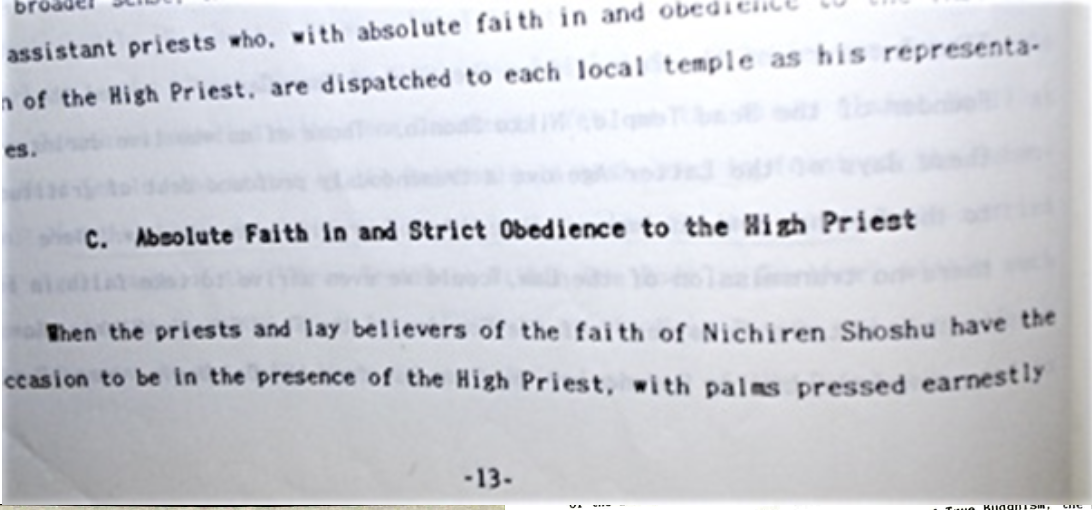
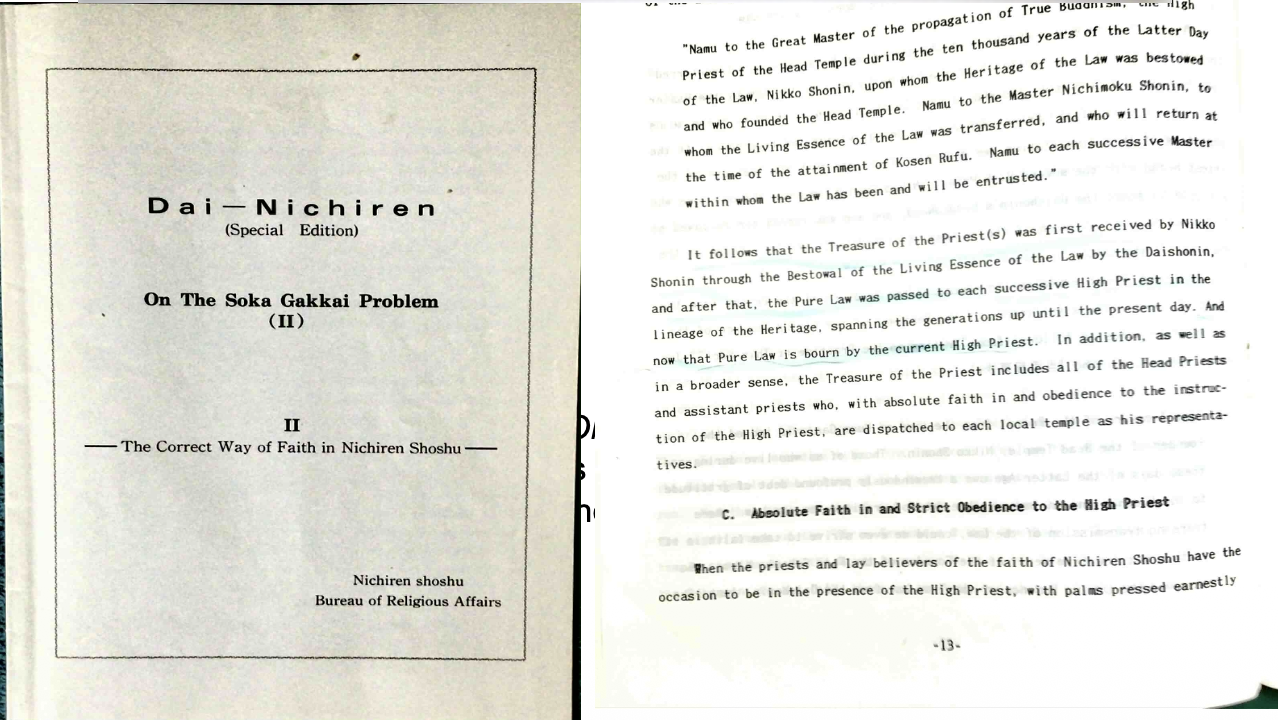
In the official publication of the Head Temple of Nichiren Shoshu, the DaiNichiren, which targeted the “Problem between the Priesthood and Lay Believers” - the priesthood demanded from lay believers who chant the Daimoku: “Absolute Obedience”:
Source: DaiNichiren (Special Edition) On The Soka Gakkai Problem (II) -13- The Correct Way of Faith in Nichiren Shoshu
(The following is the Priesthood published text on page 13, similar to other pages of the document):
………………………………………………………………………………………
“Namu to the Great Master of the propagation of True Priest of the Head Temple during the ten thousand years of the Latter Days of the Law, Nikko Shonin, upon whose the Heritage of the Law was bestowed and who founded the Head Temple. Namu to the Master Nichimoku Shonin, to whom the Living Essence of the Law was transferred, and who will return at the time of the attainment of Kosen Rufu. Namu to each successive Master within whom the Law has been and will be entrusted.
It follows that the Treasure of the Priest(s) was first received by Nikko Shonin through the Bestowal of the Living Essence of the Law by the Daishonin, and after that, the Pure Law was passed to each successive High Priest in the Lineage of the Heritage, spanning the generations up until the present day. And now that Pure Law is borne by the current High Priest. In addition, as well as in a broader sense, the Treasure of the Priest includes all of the Head Priests and assistant priests who, with absolute faith in and obedience to the instruction of the High Priest, are dispatched to each local temple as his representatives.
*Absolute Faith in and Strict Obedience to the High Priest
When the priests and lay believers of the faith of Nichiren Shoshu have the occasion to be in the presence of the High Priest, with palms pressed earnestly…”*
…………………………………………………………………………………….
The Priesthood violation of ItaiDoshin
The inseparability of priests and lay believers
As the Priesthood’s document above states, the “…Treasure of the Priest includes all of the Head Priests and assistant priests”, excluding all Bodhisattvas lay believers.
The document also mentions Nikko Shonin. But all Lay Believers treasure Nikko Shonin as the Daishonin’s successor, so, the Priesthood lack argument of using the name of Nikko Shonin in their dispute with laity.
Buddhism teaches the Truth of Interconnectedness and Inseparability. Without Lay Believers how could any priest fulfil his mission?
Propagating the Daishonin’s teachings is a “shared project” and a “shared struggle” requiring harmony and mutual support between priests and lay believers, not claiming “spiritual superiority” and a treasure excluding millions of sincere Bodhisattvas.
There is No Blind Obedience in Nichiren Buddhism
There is no blind obedience in Nichiren Buddhism. In Nichiren Buddhism, “Absolute Faith” is absolute faith in the Mystic Law, not in the person of high priest. Strict Obedience is the unwavering devotion to the Daishonin’s teachings, and not to the person of high priest.
Rejecting Nichiren Shoshu Administration demand for “absolute obedience” - both Lay Believers and the Reformists Priests together agree on mutually support of each others in their shared mission of KosenRufu, with the spirit of mutual trust - not orders and blind obedience.