Nichiren Shoshu Incoherent Prayers
In his various letters, Nichiren Daishonin has clearly defined the practice of reciting portions of the Lotus Sutra; for example:
“I have written out the prose section of the Hoben chapter for you. You should recite it together with the Jigage, which I sent you earlier”.
Source: Reply to the Lay Priest Soya.
The Daishonin explained that the “verse section of the Life Span chapter”, the jigage:
“.. represents the soul of the twenty-eight chapters of the Lotus Sutra”
Source: Letter to Horen
And he further states:
“Consequently, the Buddhas throughout the ten directions looked up to the verse section of the “Life Span” chapter as their teacher and attained Buddhahood. This verse section is like a father and a mother to the people of the world”.
Despite Nichiren’s clarity in setting his instructions about what parts of the Lotus Sutra to be recited, the Priesthood of Nichiren Shoshu decided to “correct the Daishonin” by implying that he forgot the importance of the “prose section” of the Life Span chapter.
The Priesthood decision to “correct the Daishonin”
In their arrangement of Gongyo recitation, the Priesthood calls the Expedient Means (Hoben chapter): as [part A], then the prose section of the Life Span chapter (Chogyo) is called [part B], while the verse section is called [part C]. (source: Myosetsuji Temple https://nstny.org/new-members)
But the teaching that the Buddha expounded in the prose (Chogyo) section of the “Life Span” chapter is indeed repeated in the jigage. That’s why the Daishonin focused on reciting the verse section only.
The words “Verse Section” repeat 30 times in Nichiren’s letters, and the verse section, jigage, does not only repeat the teaching of the chapter’s prose (Chogyo) section, but it is still more clearly intended for the future and more strongly imbued with the Buddha’s compassion.
Obviously then, there is no justification to add the prose (Chogyo) to the recitation in Nichiren Shoshu prayer book and practice. The Priesthood decided to include it in their practice, as if the Daishonin’s frequent insistence to recite the Jigage verse section was - in their opinion - not sufficient.
Incoherent and Arbitrary Structure of Gongyo
Nichiren Shoshu Prayer system is based on 5 prayers in the morning and 3 in the evening.
The numbers 5 + 3 are quite arbitrary. There is no documentary or reason proof for this combination. Nothing in the Gosho indicates that there is any significance or need for repetition of 5 times of the same text in the morning - or 3 times in the evening.
There is also no reason why the morning set of prayers should be different from the evening set.
But, the frequently given answer (by priests) is that it is a “priesthood tradition” to make morning prayers longer than evening ones. This maybe convenient for priests but not for ordinary people’s busy morning - and in any case, the numbers 5 prayers then 3 prayers are lacking any rational explanation and remain as a superstitious tradition.
Turning the head away from the Gohonzon at the first prayer
The Priesthood’s instruction to start morning Gongyo by a prayer for the Buddhist gods (Shoten Zenjin) exemplified by the Sun goddess - requires shifting one’s head away from the direction of facing the Object of Devotion - to look eastward.
To turn one’s head away from the most valued object of devotion and look elsewhere during prayer is rather a disrespectful movement, which - in any case - is also completely meaningless. It is meaningless because the Shoten Zenjin are already inscribed within the Gohonzon.
The Gohonzon is complete. There is no need to look elsewhere while facing the Object of Devotion.
Conclusion:
- Nichiren Shoshu Priesthood system of prayers is not supported by the Daishonin’s recommendations for reciting portions of the Lotus Sutra, which he clearly mentioned in his letters.
- Adding to what Nichiren specifically recommended (to recite the Jigage verse section), adding another part (Chogyo) - and which essence is already included in the Jigage - seems like the Priesthood correcting the Daishonin in “something he missed” in the way recitation should be conducted.
- The arbitrary numbers of prayers with differing lengths in the morning and evening is a “tradition” that has no reason nor any meaningful justification, apart from the Priesthood tendency of overwhelming and seeking complexity and rituals - which was never the Daishonin’s attitude in spiritual practice.
- The Priesthood unreasonable ritual of shifting focus from the direction of the Object of Devotion to face the East is both meaningless and disrespectful for the Object of Devotion.
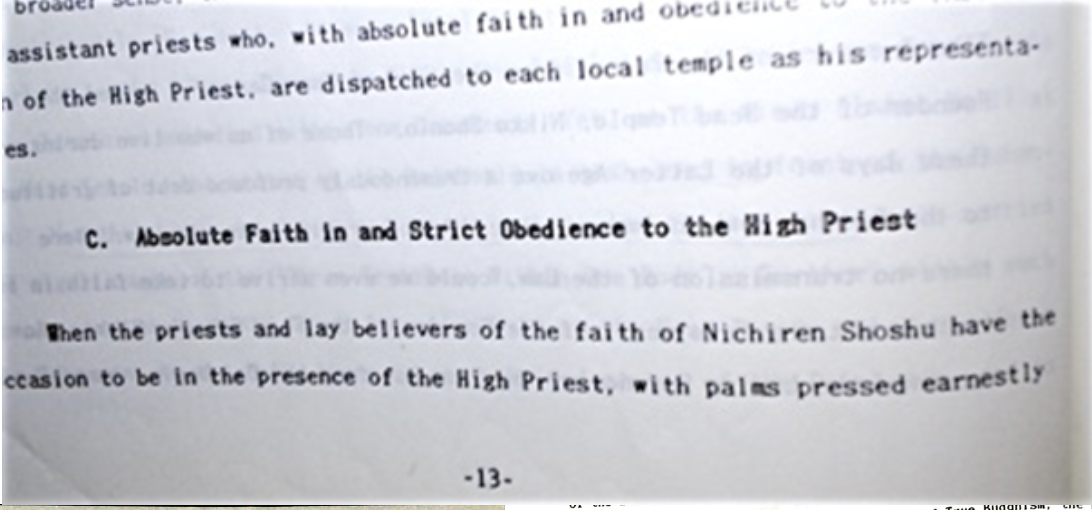
The existing mismatch between the Priesthood arbitrary and unreasonable system of prayers - with the Daishonin’s recommendations - was not possible to investigate or ask questions about in the past, because the priesthood demanded “absolute obedience” to their tradition.
When the time was right - the original recommendations of the Daishonin for conducting Gongyo were restored by the Community of Bodhisattvas of ordinary people supported by Reformist Priests.
Reference of the Priesthood Demand for “Absolute Obedience”: